Friday, August 27, 2010

Eastern Airlines 1952 Ground Signal Guide

THE GROUND SIGNALMAN AND HIS SIGNALS 1950'S STYLE
CHECKOUT THAT HAT ..LOOKS LIKE A GAS STATION ATTENDANT!

TAG ALL PHOTOS TO ENLARGE


Tuesday, August 24, 2010

CRASH OF EAL FLIGHT 512 ... DC-7B , N851D


HEADLINES POTTSVILLE REPUBLICAN
TAG ALL PHOTOS TO ENLARGE

NOVEMBER 30, 1962
THE CRASH OF EASTERN AIRLINES FLIGHT 512, DC-7B , N851D


Eastern Airlines Flight 512, bound from Charlotte, N.C. to Idelwild Airport, a DC-7B four-engine aircraft, arrived over the New York City area at approximately 9:00 P. M. on November 30, 1962.
The DC-7B was one of seven Eastern Air Lines flights daily from Charlotte to New York. It arrived here at 6:25 p. m. from New York and started on its non-stop 2-hour return flight at 7:05 p. m. when Douglas Municipal Airport was bustling with activity
The crew previously had been informed that due to adverse weather conditions the flight might have to be diverted to Philadelphia. While in its holding pattern, the aircraft was advised that "there was pretty bad fog on the airport," and that as a result "some [planes] are making it and some are not."
At approximately 9:37,Idelwild Approach Control cleared EAL 512 for an instrument landing system (ILS) approach to Runway 4 Right. Such an approach required the controller to guide the aircraft by radar until the plane intercepted a localizer beam, at which point the crew assumed full navigation of the plane.
Then at 9:45 P.M. something went horribly wrong.


On December 1, 1962 the Associated Press released the following story.
THE POTTSVILLE REPUBLICAN NEWSPAPER….
25 KILLED IN FOG-SHROUDED PLANE CRASH AT IDLEWILD
26 SCRAMBLE TO SAFETY THROUGH EMERGENCY EXITS


New York…An airliner groping through a fog crashed with a loss of 25 lives -- 26 escaped -- at Idlewild Airport Friday night in the sixth major aviation disaster in a week.
It boosted the total death toll to 206.
The latest in the series of accidents at 9:45 p. m., kept the airport closed until 7:10 a. m. today, delaying more than 50 flights.
Federal investigators converged at the airport to determine the cause. Another airliner had landed safely only 90 seconds before.
The plane, an Eastern Air Lines four-engined DC7B bound here from Charlotte, N. C., slewed into a marsh and burned.
Airport tower controllers sighted the plane about a mile from its runway and everything appeared normal, said Oscar Bake, Eastern regional assistant administrator for the Federal Aviation Agency.

FOG CUT VISIBILITY

"From this point on, because of intervening ground fog, tower personnel were not able to see the aircraft," he related. "At approximate touchdown time, the tower saw an orange glow from the direction of Runway 4-R."
Investigators said the plane was coming in for an instrument landing, along with visual checks by the pilot.
They disclosed that one of two instrument approach landing systems was not working, but expressed doubt that this had anything to do with the crash.
William L. Lamb, air safety investigator for the Civil Aeronautics Board, said the precision approach radar system was out of operation because instruments were being moved from one room to another in the control tower.
A second system -- the instrument landing system -- was working.

PILOT’S CHOICE

Lamb said the pilot presumably knew that one system was out. He said that, when both were working, it was usually the pilot's choice which to use.
The city mortuary reported that 23 of the 25 victims were men and that the other two apparently were women.
Aboard were 46 passengers and five crew members. Three crew members perished and two, stewardesses, survived.
The crewmen who perished were Capt. EDWARD J. BECHTOLD, 43, the pilot, of Laurel Hollow, N. Y.; JULES WAGNER, co-pilot of Cambria Heights, N. Y.; and ROBERT L. VORKEES, 31, pilot-flight engineer, of Comoack, N. Y.
Officials declined comment on the cause of the crash pending investigation. Survivors scrambled through emergency exits, crawling and running from the flames that engulfed the forward portion of the propeller-driven Eastern Air Lines DC7B, arriving from Charlotte, N. C. Idlewild had been completely covered by fog earlier in the evening and Capt. EDWARD BECHTOLD, a veteran frequently used as an export cross-examiner in government inquiries into crashes told the passengers he might try to land at Philadelphia.
"We don't know what made him change his mind," said LEONARD CLEMENTI of Huntington, Long Island, one of the injured survivors.
Another passenger, LOU LOUFT, a movie producer from Dover, N. J., recalled the pilot announcing: "We can make it. There is a little hole. We should be down in about six minutes."
On instrument control, the big airliner started descending from the eastern side of the busy airport on Long Island, the side toward Queens, Brooklyn and Manhattan.

LIGHTS VISIBLE

"We could see the lights as we came down," said HELEN FOURNIER, 21, of Forest Hills, Queens, one of the two stewardesses on Eastern's Flight 512. Both survived.
"Then we came down with a bang," she continued. "It was kind of quick. It seemed that the pilot was increasing the power, but we didn't get anywhere. Then there was a sort of flash. There was no explosion, though."
Several passengers recalled what seemed to be a desperate effort by BECHTOLD to get the lumbering aircraft back into the air.

TAIL END HITS GROUND

"The tail end of the plane hit the ground and the plane slewed around," said M. V. LITTLE, 54, of Garden City, Long Island.
Hurtling across a reedfilled marsh, 200 yards west of the runway, the aircraft smashed to a half and burst into flames.
It split open down the back. Seats were tossed into the foggy darkness, some with bodies still strapped into place for landing.
WALTER MUELLER of Floral Park, N. Y., told of the thoughts burned into his memory: "The first thing that enters your mind is: 'I've had it.' You're not sure in your mind that you're living. You just do things."
"The flames came into the plane from the front end before we ever stopped," said LOUFT, producer of Louft Productions, Inc., a motion pictures firm.
He was returning from a commercial film assignment in Charlotte with his two partners, script-writer FRANK SMITH, 72, of Manhattan, and production manager FRANK KOLAREK, who lives near Idlewild. All survived.


REHEARSAL SAVES LIVES

Before leaving North Carolina, KOLAREK rehearsed how to open the emergency exit beside his seat.
"KOLAREK saved several of our lives because he got that window open immediately," SMITH said.
Passengers leaped and tumbled through the openings, driven by the flames and fear.
"We kept pushing passengers out," stewardess FOURNIER recalled. "First one out and then another one. We pushed them all out. When everyone was out that I could see. I jumped to the ground. I ran and ran and I stopped and I said, 'No, I can't do this. I must help them.'"
She returned to the flaming wreckage and helped drag and guide survivors away from the intense heat.
ONE MAN ON FIRE
"One man was on fire," she said. "His whole body was burning. I put him out” Passengers, too, returned from safety to try to aid their less fortunate travelers.
Ambulances, guided by men on foot, crept toward the scene. Elsewhere in the fog blanket on Idlewild, five airliners were "lost," holding their positions on the ground, awaiting police cars to guide them to some haven.
Staffs at three hospitals mobilized to handle the injured, and two doctors from Peninsula General Hospital went to the airfield.
COUNT 25 BODIES
"There were 25 bodies, including one child," said DR. OSWARD MORAN. "I counted them. It was terrible. All of them were burned."
The crash was Eastern's first since an Electra turbojet plunged into Boston harbor shortly after taking off Oct. 6, 1960, killing 62 persons.
Idlewild's last crash occurred just nine months ago, on March 1. An American Airlines transcontinental jet climbing from the runway faltered and dived into Jamaica Bay, carrying all 95 persons aboard to their deaths.

SURVIVORS STORY
“Plane Came Down All Of A Sudden”

New York AP… There are more than a score of voices left to tell the last moments-split seconds filled with flashes of fire, explosions and final disintegration.
These are graphic expressions used by some of the 26 survivors of Friday night’s crash of an Eastern Air Lines four engine plane.
Twenty-five voices are stilled forever. They were among the 51 aboard the piston propelled DC-7B who lost their lives in the fog shrouded crash.
Stewardess Helen Fournier of Forest Hills, Queens was one of the survivors.

ORANGE FLAMES THEN SMOKE

She said this of her experience. “The plane came down all of a sudden. It didn’t stop. There was an orange flame. Immediately the plane filled with smoke.”
Walter Mueller, of Floral Park , N.Y. said the craft “disintegrated into a huge ball of fire. In a split second flames were all over.”
Donald Barbour, 36 of Coxsackie, N.Y. where he is manager of Special Heating Products, had praise for the pilot’s unsuccessful attempts to raise the plane off the ground after it first touched down.
He praised the stewardesses saying, “They were really terrific in helping the passengers. I think they more than you could humanly expect them to.”
M.V. Little of Huntington Station, N.Y. was asked if their was any panic in the plane following the crash.
“Hell yes,” he replied. “Everyone was trying to get the hell out of there.”


SHOWN BELOW.... PARTS OF THE CAB INVESTIGATION INTO THE CRASH OF FLIGHT 512

Eastern 512 Crash Investigation

Eastern Air Lines Flight 512, a Douglas DC-7B, N 815D, crashed during an attempted go-around following an instrument approach to runway 4R at New York International Airport, at 2145 e.s.t., on November 30, 1962 Of the 51 persons aboard, 21 passengers, 3 crew members and an additional crew member occupying the jump seat did not survive.

Flight 512, regularly scheduled from Charlotte, North Carolina, non-stop to New York International Airport, entered a fog condition near the threshold of runway 4R. A go-around was initiated; however, the aircraft struck the ground in a slightly nose-high attitude and was virtually destroyed by impact and subsequent fire.

In command of flight 512 was Captain Edward J. Bechtold, age 43, was employed by Eastern Air Lines on April 26, 1945, and had accumulated a total of 15,644 hours flight time, of which 2,700 hours were in DC-7 type aircraft. A veteran Eastern pilot and a man who was recognized as an expert on air safety. He was a member of the Air Traffic Control Committee of the Air Line Pilots Association, Chairman of the New York Air safety Committee. Captain Bechtold often criticized Idlewild's facilities, especially dealing with landing aids.

The First officer on flight 512 is Julius A. Wagner, age 45, he was employed by Eastern Air Lines on March 15, 1951, and had accumulated a total of 9,042 hours flight time. He had accumulated a total of 1,610 hours flight time in DC-7 type aircraft, of which 71 hours were as pilot-in-command.

The Pilot/Flight Engineer is Robert L. Voorhees age 31, he was employed by Eastern Air Lines on August 26, 1957, and had accumulated a total of 4,080 hours flight time. He had accumulated a total of 149 hours as pilot-engineer and 718 hours as a pilot in DC-7 aircraft.

In the cabin were Flight Attendant Helen L. Fournier was employed by Fasten Air Lines on April 16, 1962 and Flight Attendant Patricia J. Richards was employed by Eastern Air Lines on June 24, 1961.
The DC-7B was manufacturer's serial No 45084, owned and operated by Eastern Air Lines, Inc., 10 Rockefeller Plaza, New York, New York, was manufactured in September, 1956, and had a total flying time of 18,411:06 hours of which 281:91 hours had been accumulated since the last major inspection. The aircraft was powered by four Wright model 972TC18DA-3/4 engines with Hamilton Standard, model 34E60-363 propellers. Engine times were as follows:


________________________________________________________________________________
The Board determines the probable cause of this accident was the technique employed by the crew during abandonment of the approach under fog conditions not adequately reported.

Flight 512 was attempting a go-around following an instrument approach to runway 4R at Idelwild. Of the 51 persons aboard, 21 passengers, 3 crew members and an additional crew member occupying the jump seat did not survive.

The EAL forecast attached to the Dispatch Release of Plight 512 indicated clear skies or scattered clouds for Idlewild.

Flight 512 departed Charlotte at 1941 and proceeded in accordance with an Instrument Flight Rules (IFR) clearance

While en route to Idlewild, EAL 512 was in radio communication with the Atlanta, Washington, and New York Air Route Traffic Control Centers (ARTCC). The flight was also maintaining radio contact with EAL on company radio

Note:
Being that EAL 512 had no voice recorder on board all radio transcripts are taken from the CAB report.
The following transcripts are taken from the CAB accident investigation and are the authors interpretation of what transpired up and till the crash of EAL 512.

The aviation terminal forecast, valid for the period from 1800 on November 30, to 0600 on December 1, predicted partial obscuration, 3 miles visibility in haze and smoke with occasional 2 mile visibility. FAA publications indicated that the landing aids for runway 4R at Idlewild included an Instrument landing System (ILS); sequenced flashing lights; runway centerline, edge and threshold lights; taxiway lights; approach lights and rotating beacon. The Precision Approach Radar (PAR) was declared by a Notice to Airmen (NOTAM) to be out of service.


The EAL forecast attached to the Dispatch Release of Plight 512 indicated clear skies or scattered clouds for Idlewild.

19:27… The Idlewild forecast is amended by the Weather Bureau. This amended forecast was to be valid for the period from 1940 to 0600; it called for "ceiling zero obscuration, visibility zero, fog, variable to clear, visibility 1-1/2 miles ground fog."
There is no evidence that Flight 512 was advised of this forecast.

19:41… Flight 512 departs Charlotte on an IFR clearance.

20:15… TEL-autograph transceivers in the FAA control tower cab and IFR room became inoperative. This equipment is utilized to communicate written weather information between the Weather Bureau office and the control tower cab and IFR room. Also, it was discovered that the direct voice communication line (hot line) between the control tower and the Weather Bureau was inoperative.

20:23…. 512..Dispatch, If Idlewild below on arrival, you are cleared to Philadelphia.
512 roger.
512..dispatch , several other flights are diverting to Newark.

At this time the RVR digital readout in the tower for runway 4R was malfunctioning

20:45 …EAL 512 , New York you are cleared to the Sandy Hook holding pattern at fl 11.0.
20:45.. Eastern 512.

20:52… Eastern 512, New York your EAC (Expect approach Clearance) is 22:07
Eastern 512 Roger, EAC at 22:07

20:57… Eastern 512, hold at Sandy hook, right turns, and expect indefinite delay due to weather, Aircraft are landing on runway 22L.

Shortly after this transmission all traffic was changed to 4R.

21:02 … Hello Company, 512 requests Idlewild weather.
21:02 . ..512 Idlewild visibility was….now one mile. EAL Flight 330 missed approach runway 22.

21:07…NYARTCC…All aircraft this frequency inbound Idlewild, the latest weather time 0205 (2105 EST), partial obscuration; a mile and, a half with fog; landing runway four right, RVR inoperative."

21:09… Eastern 512..New York..your revised EAC now 21:40..
Eastern 512, EAC 21:40.

21:10… Company 512,, we are coming up on Sandy Hook, have an expected approach clearance time of 40 minutes after the hour, altitude 9,000 feet, and understand the visibility is now one and a half miles..

21:12…Company 512, request Idlewild landing information.

21:13…512, The Idlewild pressure altitude is 9640, Idlewild altimeter is 30.30
512, roger our field pressure is 30.31


APPROACH CHART FOR RNWY 4 AT THE TIME OF ACCIDENT.

It should be noted here that five weather observations were recorded by the observer on duty at the Idlewild Weather Bureau office between 2108 and 2153. During that period, the official visibility 4/ for Idlewild was that "prevailing visibility" observed by the FAA controllers 5/ located in the tower cab. 6/ Control tower operators are required to maintain a log of their observations of visibility. There is no documentary evidence that such log was maintained on the evening of November 30 in the Idlewild tower. There was, however, a Weather Bureau record 7/ of both prevailing visibility and surface visibility 8/ at Idlewild during the evening of November 30.

21:24.. Eastern 512, NYARTCC…contact Idlewild Approach Control on 119.7
119.7 Eastern 512

21:25 ...Idlewild Approach, EAL 512 in Sandy Hook holding pattern.
Eastern 512, Idlewild Approach..four right IlS in use, landing runway 4R..Wind calm, The Idlewild weather, sky partially obscured, visibility 1-1/2 miles with fog. Altimeter setting: three zero three one. Precision Approach Radar not available. Middle marker, middle locator, Runway Four Right inoperative; Runway visual range Four Right inoperative."

At this same time, EAL Flight 620, a turbojet aircraft, landed on runway 4R at Idlewild, Shortly

21:27…Idlewild Approach, United 500, (A DC-6) making a missed approach on 4R, That stuff is no more than fifty feet thick and is really thick.
21:28… United 500 , Idlewild Approach,,Were almost on top of it here in the seventh floor, we can hardly see the ground…Good old fashioned ground fog..

At the time of this conversation another United 712 a Turbo jet landed on 4R.

21:30…This is Idlewild Approach… All aircraft copy. Runway Four Fight ILS in use. Landing Four Right Wind northeast six, altimeter three zero three one. Idlewild weather, sky partially obscured, visibility is one and one half miles with ground fog, and, just got out new visibility, its one mile now. One mile with ground fog Runway visual range four right inoperative. Middle locator Four Right inoperative, and Precision Approach Radar not available.

21:32.. Following this transmission, American Airlines Flight 996, a turbojet aircraft, landed on runway 4R

21:33. Eastern 512, Idlewild Approach, descend and maintain 6,000 feet. Radar vectors to ILS final approach. (vectors not given)

21:34.. Idlewild Approach … sky partially obscured; visibility one mile with ground fog; and wind is northeast at six, altimeter setting 30.31.
2134,…American Airlines Flight 910, a turbojet aircraft, landed on runway 4R.

21:37…TWA 46, a turbojet lands on runway 4R

21:39:11..Eastern 512, Idlewild, you are nine miles southwest of the ILS outer marker, contact tower on 119.1

21:39:59.. Idlewild Approach Approach Control gave a new weather broadcast of 3/4 mile visibility in ground fog on frequency 119.7
.
2139,…UAL Flight 950,at DC-7 aircraft, landed on runway 4R. This landing was described by Captain L. W. Witlow as: "Just after my First Officer . . . reported to IDL approach control the IDL 4R LOM (outer marker) inbound he remarked 'I can see the glow of the approach lights', shortly thereafter he remarked 'I can see the approach lights but not the runway'. I then looked out and observed the full line of approach lights and the runway lights on the approach end. From that point on, I made a visual approach referring to my ILS instrument so as to stay on the glide slope, which I did until I was definitely over the runway.'

21:41… Eastern 512 is approaching the OM, while United Flight 164 was landing on 4R. The captain of UAL 164 described his landing as follows: "Either at or shortly after passing the outer marker the glow of the approach lights was visible through the fog . . . The flight was, until this point, made in clear air with clear skies above Lights were clearly visible either on or very near the airport. Prior to reaching the middle marker, the threshold lights were observed . . . Landing was effected at 2141 EST in visibility that I would judge to be somewhat less than 3/4 mile. An accurate appraisal of visibility during the last 20 feet before touchdown was virtually impossible due to the brilliance of the runway lighting." At approximately this time, a Sabena turbojet aircraft, located on the ground at Idlewild one mile northwest of the threshold of runway 4R, was cleared for takeoff on runway 7R. The Sabena crew informed the control tower on VHF radio frequency 119.1 that visibility was ". . . a bit too poor . . ." and, requested a delay.

21:42.. Idlewild Tower Eastern 512 just passed the Outer Marker.
Eastern 512 Idlewild Tower ...the condenser discharge sequenced flashing lights in the approach light system are being turned on let us know if you want them off.

21:43… Eastern 512.. Idlewild Tower, you are cleared to land.
EAL 512.. Ok, please dim the flasher.
Tower.. Roger, I have to shut them off.

This was the last communication with Eastern 512.

21:44 EAL Flight 406, a Electra turboprop aircraft, was immediately preceding Flight 512 in the landing traffic for runway 4R. EAL 406 landed on 4R. The captain of EAL 406 indicated that approaching the airport the sky was clear and the approach lights could be seen prior to the outer marker. After passing the outer marker he lost the lights temporarily, but they became visible again before the middle marker. From this point, the run-way and threshold lights were also visible; however, fog described as variable, was encountered. He stated that ". . . after landing, we ran into very thick fog at the northeast end of the runway causing a little delay in clearing at the end."

The crew of EAL 512 did not report the runway in sight passing the middle marker, a required report. Two tower controllers observed the red rotating beacon light on the aircraft disappear in a fog condition 1/2 mile from the end, of runway 4R

21:44… EAL 512 Idlewild Tower advise when it was clear of runway 4R. There was no response.

21:45… Idlewild Tower…American 8, passing the outer marker, Tower. . we got a bright light ahead of us, appears near the airport - you got any information?"
21:46…American 8 ..Idlewild Tower overfly the runway and report while over the runway, 21:46…Tower….American 8. . . Runway four right appears to be clear, we got a fire in sight down there . . . to the left of the runway.


The Crash

EAL 512 crashed approximately 2,500 feet beyond the ILS touchdown point 9/ on the left side of runway 4R at 2145. After the accident, at 2150, a weather observation was recorded with " . . . visibility 3/4. mile in fog . . . surface visibility 1/8 mile." The landing minimums for EAL 512 were 200 feet ceiling and 1/2 mile visibility. The "surface visibility" observations of the Weather Bureau were not communicated by the FAA tower personnel to EAL 512 on any recorded communications frequency. Tower personnel stated that the Weather Bureau observations for the period 2108 to 2150 were not received by them. The Weather Bureau observer at Idlewild did not recall specifically advising any person in the control tower of the "surface visibility." He said: "I do not remember sending out any observation. The only thing I can say is I do not remember not sending out any observations."

The first impact marks made by the aircraft were slashes from the Nos. 1 and 2 propellers. These marks were located 3,460 feet from the threshold center of runway 4R, on a bearing of 37 degrees. Computations based on reed cuts and propeller slashes indicate a flight path impact angle of 2 degrees-with a 6-degree bark to the left and an airspeed of 135 knots. A splash mark from the tail-skid, commencing 50 feet before the main impact, indicated an aircraft attitude of 3 to 5 degrees nose high.

Breakup of the wings and fuselage occurred on a mound of earth approximately 3 feet high, located 3,600 feet from the threshold center of runway 4R, on a bearing of 37 degrees. The left wing failed near the wing root, between the Nos. 1 and 2 engine nacelles, and at the tip. The left wing fuel tanks ruptured, resulting in ground fire which burned a large area just beyond the mound. The right wing separated at the wing root with portions of the upper and lower fuselage skin fairing and structure still attached.

The aircraft fuselage separated at impact in the vicinity of the aft wing spar with the forward portion coming to rest 90 degrees to the wreckage path. This break occurred approximately at the cabin partition between the forward tourist and aft first-class sections. All survivors, 6 tourist, 18 first-class passengers and 2 stewardesses, exited through the main passenger door, aft emergency exit door or windows, or through breaks in the fuselage. They reported seeing fire from the wings immediately on impact, followed by fire inside the cabin a few seconds later. As a result of this fire both stewardesses, who had been seated in the aft lounge, were unable to see forward of the galley area by the main loading door.

The nose landing gear was separated from the aircraft; the actuating cylinder indicated it was fully up at impact. The main landing gear was found in the retracted position. There were no landing gear gouge marks along the wreckage swath. All three landing gears on the DC-7 retract in the forward direction, and retraction time is about 7 seconds.

The flap-actuating cylinders indicated the left flap was set at approximately 20 degrees or "takeoff" position at impact. The right flap actuating cylinders corresponded to an approximate setting of 10 degrees. Examination of the flap actuator on the flight deck indicated a 20-degree flap position had been selected at impact. The right flap bus cable turn-buckle was found broken; however, a laboratory examination revealed that this break could only occur to this type of brass when under a tension load, at a very high temperature. Wing flap control valve cable continuity could not be traced to the cockpit controls because of fire damage.

All four engines received considerable impact damage, with various components being torn loose or broken away. Examination of the engines revealed no evidence to indicate pre-impact failure, operational distress or malfunction. Tests of the propeller governors revealed that engine speeds for Nos. 1, 2, 3, and 4 had been 2,474, 2,445, 2,463, and 2,422 r.p.m., respectively. Propeller shim plate markings indicate blade angles at impact were 37, 37, 36, and 38 degrees, respectively, for the Nos. 1, 2, 3, and 4 propellers. At impact, the approximate horsepowers being produced by engines Nos. 1, 2, 3, and 4 were 2035, 1950, 1993, and 1890, respectively. Normal engine horsepower for a landing approach is approximately 1,000 horsepower per engine.

A few hours after the accident, at 0245 on December 1, 1962, the FAA made a flight check of the complete ILS serving runway 4R. This check disclosed that the front course of the localizer, glide slope, and markers were operable and within required tolerances at that time. A further check was conducted on December 4, 1962. The purpose of this flight was to determine whether or not Lockheed Electra L-188 on the instrument runway, or taxing near the localizer antenna, would affect the presentation of instruments in an aircraft making an approach. Three approaches were made under these conditions and no abnormalities were noted in the localizer course from over the outer marker to the runway threshold. The latter test was prompted by concern that an Electra, which had, landed approximately one minute before Flight 512, might have interfered with localizer signals.

Eastern Air Lines FAA-approved DC-7B Flight Manual describes the go-around procedure with four engines operating as follows:

"1.
Captain applies or calls for power as required usually METO. NOTE: At airspeeds expected at the start of a go-around, the use of T.O. r.p.m. and power not normally needed. If go-around from balked landing is made with full flaps and gear down and speed reduced to approximately minimum landing, T.O. power and. r.p.m. may be necessary.

2.
Wing flaps - TAKEOFF position.

3.
Landing Gear - UP.

4.
Normal CLIMB POWER after landing gear is UP.

5.
Wing flaps may be left at TAKEOFF position or retracted at captains discretion."

The chief pilot of the Douglas Aircraft Company was questioned about the DC-7 performance and acceleration characteristics in various configurations. He stated that power application as low as 2,100 to 2,200 horsepower per engine, instead of METO, at the start of a go-around in the landing configuration, would, produce a low rate of climb initially, and a slower transition to a climb. There would be no tendency for the aircraft to roll or yaw if all engines are accelerated evenly. He further stated that with a gross weight of approximately 96,000 pounds and "Using the landing configuration of gear down, flaps full and using all four engines at takeoff power, the angle of climb for a speed of 115 knots would be approximately 3 degrees. That's the noseup, and that would be using the airplane fuselage as the reference line on the horizon . . . at the same configuration, speed at 135 knots the angle would be 2 degrees. For configuration of flaps 20 degrees, and the gear up, using all four engines at takeoff power, the angle with 115 knots would be 9 degrees noseup, and 135 knots would be 8 degrees noseup." If less than takeoff power were used, in the 2100 or 2200 horsepower per engine range, ". . the angle would be slightly less."

He also stated that with a gross weight of 96,000 pounds, brake horse-power of 2,250 and 2,600 r.p.m. at sea level on a standard day the aircraft would accelerate at a rate of approximately 2 knots per second. Placing the flaps at 20 degrees, 40 degrees, and finally at 50 degrees flaps and gear down the acceleration would drop to approximately 1.52, 1, and. slightly less than 1 knot per second, respectively. He further stated that using an airspeed of approximately 115 knots, at maximum landing weight, "There would be no problem at all to pull it up and rotate it . . . into . . a balk-landing climb."

Analysis


The investigation revealed no evidence of control system, powerplant, or structural failure. The forces to which the aircraft was subjected when it struck the mound of earth near the point of initial impact, undoubtedly contributed to the extensive breakup of the structure.

The system of weather observation and reporting as it concerned the flight deserve special attention. The U. S. Weather Bureau, the Federal Aviation Agency tower controllers, and the Eastern Air Lines dispatch organization each had, duties relating to weather observation and reporting. The system placed the initial responsibility on the Weather Bureau to observe and record the weather information. Since the official Idlewild, visibility was less than four miles, the responsibility for taking visibility observations was assumed by the FAA tower controllers. There was an exception in the rules which provided that the responsibility for taking official visibility observations would revert from the tower to the Weather Bureau, when the tower was above the top of the phenomena. However, during the period with which this report is concerned, the tower was observing restricted visibilities which indicated that the top of the phenomena was, in fact, above the tower. The FAA tower controllers furnish meteorological information to aircraft in flight, particularly in the terminal area. The prime responsibility for furnishing significant weather information to EAL 512 while en route was a duty of the Eastern Air Lines dispatcher.

The information furnished to EAL 512 did indicate that the weather situation at Idlewild was deteriorating. These reports included notification of indefinite delays due to weather; alternate airport information; that company traffic missed an approach and that the visibility was one mile when the flight departed Sandy Hook holding pattern. The information contained in the remarks section of the Weather Bureau observations which indicated that the "surface visibilities" were less than the reported official visibility were not furnished to the crew of EAL 512. Further, the Approach control broadcast of the 2136 special observation, which included "visibility 3/4 mile in ground fog" was made at 2139:59, or after EAL 512 had been instructed to change to tower frequency.

Owing to the vertical and horizontal separation of the tower cab from the approach end of runway 4R, the tower visibility observation was not representative of the condition along the runway. However, since the tower RVR was considered inoperative, the governing visibility factor applicable to landing minimums of 1/2 mile visibility was that observed by the tower controller. It was on this basis that the airport remained "above minimums" while EAL 512 attempted an approach.

There were two indications of poor visibility which the crew of EAL 512 should have heard during their approach. The crew of an aircraft clearing the runway reported experiencing visibility of 50-60 feet. In addition, the jet flight awaiting departure from runway 7R requested a takeoff delay for weather improvement. These transmissions all took place on tower frequency, which EAL 512 had been instructed to monitor shortly prior thereto. However, if the crew of EAL 512 was aware of these reports, the knowledge that company traffic bad landed immediately ahead of them, at 2144, could have offset any apprehension they may have had regarding the successful completion of their approach.

Since the captain of EAL 406, which landed immediately ahead of EAL 512, stated that he saw the approach, runway, and threshold lights from the middle marker, and since the pilot of EAL 512 requested that the "flashers" be dimmed, it is presumed that he was encountering similar weather conditions. During the approach, EAL 512 should have been at 197 feet above the field elevation over the middle marker. A decision must have been made at this point either to complete the approach or go around. Although the transcript of recorded communications did not reflect passage of the middle marker or the captain's intention at that tine, it is concluded from the testimony of surviving passengers that the captain elected to continue his approach and effect a landing. From the middle marker-to the runway threshold, altitude and airspeed were reduced in preparation for the landing. As the aircraft continued to descend, a rapid deterioration of visual reference was encountered in thick fog. This fog was similar to that observed by crews awaiting takeoff on runway 7R, and by crews that landed on runway 4R. When visual reference was lost, the pilot elected to go around.

Attached to this report is a drawing depicting the probable flight profile of EAL 512 which indicates that:
1.


The aircraft was on the glide path at the middle marker with its gear down, flaps at 30 degrees, airspeed at 130 knots, descending at 574. feet per minute and a constant power of 100 BMEP at 2,450 r.p.m., or 1,040 brake horsepower per engine.

2. As the runway threshold was approached, flap extension from 30 degrees to 40 degrees was initiated at an altitude of approximately 75 to 80 feet. The extension of flaps from 30 decrees to 40 degrees required 2 seconds, during which time the aircraft decelerated approximately 1 knot to 129 knots. A slight deviation above the glide slope occurred when the crew, seeing the threshold and some of the runway lights, began to execute a visual approach.

3. After crossing the threshold, the aircraft continued along a flightpath of 1-1/2 degrees slope downward and about 6 degrees to the left of the runway heading for 8-3/4 seconds. During this period, there was a rapid deterioration of visual reference when thick ground, fog was encountered. At the end of this period, the aircraft had decelerated to a speed of 124-1/2 knots and had descended to an altitude of approximately 25 feet above the ground. After perceiving the fog and evaluating the situation, the crew of EAL 512 elected to abandon the approach. Without increasing the r.p.m., slightly more than climb power was applied, and the landing gear was retracted coincident with retraction of the flaps to 20 degrees. The nose of the aircraft was rotated upwards to between 3 to 5 degrees above the level position. The missed approach procedure was initiated about 1,000 feet beyond the ILS touchdown point, to the left of the runway, altitude about 25 feet.

Execution of the missed approach procedure by the crew of EAL 512 necessitated a transition to instrument reference due to the loss o visual reference. This had to be accomplished at an extremely low altitude. There was little time or margin for error if the maneuver was to be successfully accomplished.

The DC-7B aircraft in the landing configuration can be transitioned from the landing attitude to a climb without loss of altitude. In order to accomplish this, takeoff power, or even climb power, with aircraft rotation to approximately a 3-degree noseup attitude is required. The retraction of flaps to 20 degrees during such a transition requires an aircraft rotation to approximately to a 9 degree noseup attitude, in order to compensate for the loss of lift as the flaps are retracted. Surviving passengers did not experience the pronounced charge in altitude which would have resulted from aircraft rotation to 9 degrees noseup during the crew's execution of the missed approach. The ground impact splash from the tail skid confirmed a 3-to 5-degree noseup attitude.

The amount of power application and, the degree of aircraft rotation used by the crew of EAL 512 should have been adequate to accomplish the pull-out, had, the flaps and gear remained extended. However, inasmuch as flap and gear retraction was effected prior to establishing a positive rate of climb, either one of two actions by the crew would have precluded the aircraft settling into the ground:

1. Additional aircraft rotation, commensurate with the power utilized.

2. Use of the remaining power available.

The Board concludes that additional aircraft rotation was not effected due to a lack of immediate instrument orientation, and that additional power was either not requested, or delayed because of other duties.


Probable Cause

The Board determines the probable cause of this accident was the technique employed by the crew during abandonment of the approach under fog conditions not adequately reported.

Recommendations

Following this accident the Board sent recommendations to the Federal Aviation Agency and the United States Weather Bureau. These recommendations and the responses thereto were as follows:

1. It was recommended that the Air Traffic Control procedures require the transmission of all operationally significant weather information in terminal areas to approaching aircraft. The FAA, by letter dated January 8, 1963, stated that the necessary procedural changes were being prepared.

2. It was recommended that the RVR instrumentation in the recently commissioned IFR room of the Idlewild tower was inadequate. Also, the Board requested a study of the physical arrangements in all towers where PAR is installed. On January 11, 1963, the FAA stated that corrective action was being taken and that a new program would permit installation of five RVR indicators in a tower facility.

3. It was recommended that an alternate method be developed to determine runway visibility when the RVR is inoperative. This was to be accomplished by utilizing runway observers, certificated by the Weather Bureau. On January 14, 1963, the FAA stated that this procedure would be implemented on a trial basis in New York, Chicago, and Los Angeles. The Weather Bureau indicated concurrence with the recommendation on January 8, 1963.

4. The Weather Bureau, was informed that the staffing plan of the Weather Bureau Airport Station at Idlewild was inadequate to maintain proper surveillance of all the weather recording devices available. On January 8, 1963, the Weather Bureau indicated, that corrective action would be taken.

5. It was recommended that the Weather Bureau amend their methods of observing and, reporting prevailing weather when "partial obscurations" are present. The Weather Bureau indicated concurrence with this recommendation on January 8, 1963.

6. The FAA was informed that there was a period of time on the evening of this accident when no record of tower visibility observations was retained. It was recommended that the responsible activities should be recording and reporting the same values of visibilities at all times and that there should be a written record of all tower visibility observations, on February 4, 1963, the FAA stated that operations procedures were being developed to accomplish this end.

7. It was recommended that the "Remarks" portion of weather reports be broadcast to aircraft. The FAA informed the Board that a priority project had been initiated to standardize the transmission of weather information from ATC facilities to airmen in flight.

BY THE CIVIL AERONAUTICS BOARD:

/s/ ALAN S. BOYD
Chairman


Saturday, June 26, 2010

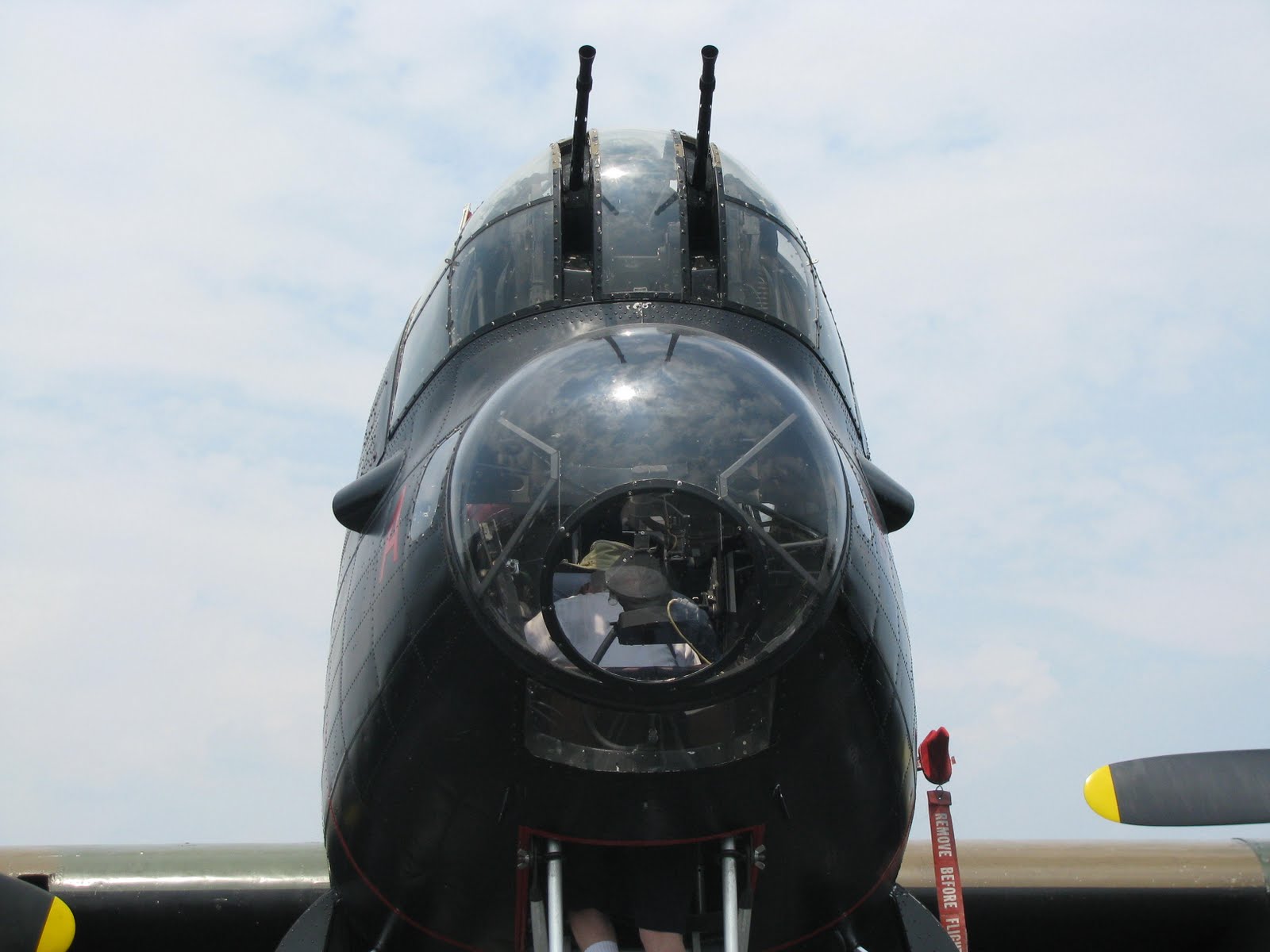
LANCASTER BOMBER VR-A


CAPTURED THESE PHOTOS OF THE CANADIAN LANCASTER AT THE WORLD WAR 2 WEEKEND AT THE READING AIRPORT, PENNSYLVANIA.
WHAT A GREAT OLD BIRD WAS THRILLED TO GET TO CRAWL AROUND HER.

Specifications (Lancaster Mk I):
Engines: Four 1,460 hp Rolls-Royce Merlin XX inline piston engines.
Weight: Empty 36,900 lbs, Maximum Takeoff 68,000 lbs.
Wingspan: 102 ft 0 in.
Length 69 ft 6 in.
Height: 20 ft 0 in.
Performance:
Maximum Speed at 12,000 ft: 287 mph
Service Ceiling: 24,500 ft
Range with 14,000 pound load: 1,660 miles
Armament:
Two 0.303-inch (7.7mm) guns in nose, ventral and dorsal turrets.
Four 0.303-inch (7.7mm) guns in tail turret.
Fourteen 1,000 pound bombs.
Crew: 7


BOMB AIMER POSITION


PILOT POSITION..NOTICE TWO YOKES


ENGINEERS PANEL RIGHT SIDE


TAIL GUNNER

Sunday, June 20, 2010

THE DORNIER DO-X

I think this bird is one of the coolest looking aircraft ever designed. It could have been featured in the movie "Dune".
The following articles are from Flight Magazine.


RARELY in the history of flying has a machine so
captured the imagination as has the large
Dornier flying ship, the " Do. X." The size is
beyond anything previously accomplished;
the lines of the machine are unusual; and the
power plant arrangements n o v e l .

Ground enough surely, for being intrigued,
and for wishing " to know all about it."
FLIGHT has published illustrations of
the Do. X on more than one occasion, and has commented
editorially on its main features. Hitherto, however, the
necessary authentic data have not been forthcoming, in
the absence of which it has been a little difficult to form a
rrue picture of what the Do. X is, and what it really means.
We have now received from Dornier Metallbauten of
Friedrichshafen on Lake Constance, a small booklet in which
is set forth an account of the underlying ideas of the Dornier
engineers in producing this machine, details given of the
construction, and accurate data supplied concerning such
items as dimensions and areas, weight, performance, etc.
Thus we feel that we are better equipped to deal with what
is the most interesting design of modern times, and that
FLIGHT readers will not mind—in fact, will wish us to—if we
return once more to the subject of the Do. X.


Dr. Claudius Dornier, like Dr. Rohrbach, began his
aeronautical career with the Zeppelin company, and during
the early days, when Rohrbach and Baumann were designing
the large four-engined Zeppelin Staaken monoplane which,
as a result of gross stupidity, was later destroyed because
of certain clauses in the Treaty of Versailles, Dr. Dornier
began to occupy himself with the subject of seaplanes and
flying-boats. He produced, first as chief designer at the
Zeppelin Lindau works and later as head of his own
company, a series of flying-boats, the earlier types of which
those sufficiently interested may find described in FLIGHT
of December 16' and 23, 1920.

Quite early in his career Dr. Dornier adopted short wing
stumps springing from the sides of the boat hull for obtaining
lateral stability on the water. In one early example, theDo. Rs. II, these stumps were braced by struts from below,
and they must have caused the machine to be very " dirty "
on the water. In those early days, too, the tail surfaces
were carried either on boom outriggers or on a fuselage
placed high above the hull. In the Gs. I, produced in 1919,
Herr Dornier for the first time carried his tail surfaces on
the main hull, which was extended right aft instead of the
rather short sort of " Bat boat " hull which he had previously
favoured. In the Do. Gs. I the wing stumps had become
pure cantilever members ; and, furthermore, the main
wing lift struts were anchored to the tips of the stumps.
The power plant consisted of two water-cooled engines in
tandem, placed above the monoplane wing. From this
machine developed as a logical outcome the Dornier Gs. II,
the Wai, and the Superwal, gradually increasing in size
and power, but retaining all the fundamental features of
the Gs. I. From that machine, therefore, may be said
to date Dr. Dornier's real programme of flying-boat development,
and the Gs. I is the ancestor of the long series of boats
which has now culminated in the production of the Do. X.
No other flying-boat designer in the world has had the
opportunities of Dornier, who, already during the war,
was not expected to turn out military aircraft which must
be immediately successful, but who was given more or less
a free hand to prepare for the future by evolving commercial
flying-boats.

We have dealt with this phase of Dr. Dornier's work
at some length, because only if on,e knows something of his
earlier history can one obtain the correct perspective for
judging his latest work. We believe we are correct in stating
that altogether Dr. Dornier has produced no less than
28 types (not all flying-boats).

Before the actual work of designing the Do. X could be
started, a large number of theoretical and scientific investigations
had to be made because, although it was not desired
to introduce any unknown features where it could be avoided,
the very size of the projected machine called for much work
in determining the most economical type of structural
members, and so forth. This preliminary work was begun
in 1924. In December, 1927, actual construction was
commenced in the new works at Altenrhein. The first test
flight was made on July 12, 1929.


Aerodynamic Design
The Do. X is a semi-cantilever monoplane flying-boat,
with the engines placed above the main wing, in six tandem
pairs, and a small auxiliary wing joining them. A good
deal of speculation concerning this wing has occupied those
interested in the Do. X, and it has even been claimed that
by fitting it Herr Dornier has obtained a " sort of slot
effect" and greater lift. We could never, personally, see ,•
any reason for this supposition, and the booklet sent us
by the Dornier company makes it quite clear that the
auxiliary wing is a structural member first and foremost,
serving to steady the engine mountings laterally.
The boat hull is of fairly normal Dornier design as
regards its external shape. Minor differences are formed
on the one hand by the control cabin, which projects
above the main deck and may be expected slightly to
increase the drag, and on the other hand by a rounding of
the stumps into the hull, which may slightly reduce
the drag. The control surfaces are fairly normal and
are all balanced by secondary surfaces. As regards the aerodynamic
efficiency of the Do. X, the aspect ratio (if
one may be so old-fashioned as to use this expression) is
low (about 5) and the s-pan loading is very high. This is,
of course, merely another way of saying that the
induced drag is high. To that the designers of the
Do. X would probably reply that this is not of serious
consequence, as the machine has a small speed range and a
high take-off speed.

If one now turns to the—in this particular instance,
perhaps, more important—question of minimum drag
coefficient, it is of considerable interest to find that this is
rather surprisingly low for a multi-engined machine. For
example, at the normal gross weight of 46 metric tons
(101,200 lbs.) the wing loading is 19-3 lbs./sq. ft. Assuming
the engines to develop a normal output of 500 h.p. each, the
total power is 6,000 b.h.p. and the power loading is 16-88
lbs.,'h.p. The " wing power " in that case is 12 -33 h.p./sq. m.
(1-15 h.p./sq. ft.). For a top speed of 130 m.p.h. this
corresponds to a " high-speed figure "• of 13, which would
appear to be as high as that attained by many smaller machines, even single-engined types. Doubtless the tandem
engine arrangement has resulted in the drag being quite
considerably lower than it would have been had the engines
been spread out.

Constructional Features
The boat hull of the Do. X is, in its outward shape, very
similar to that of previous Dornier machines. The mam
step is placed rather farther aft than in British flying--
boat hulls, and is formed with fore-and-aft shallow
steps which gradually merge into the forward vee of the
bottom. The rear step does not, as in British practice,
extend laterally out to the, chines but is of narrower
beam than the main bottom, and is fairly deep. The Germans
term this form of step a " displacement step " (Verdriingungssporn),
presumably because it acts by displacement
rather than by dynamic pressure. From the main
step to the stern post the chine members are straight
and swept up at a fairly pronounced angle so as to get
the tail well clear of the water. Forward of the step the main
bottom becomes, as already indicated, of pronounced
V-form, to terminate finally in a straight raked stem.
The total length of the boat hull is 40-05 m. (131 ft. 6 in.)-
The beam, over the stumps, is 10 m. (32 ft. 10 in.), and the
maximum beam of the hull itself is 3-5 m. (11 ft. 6 in.)-
The greatest depth of hull is 6-4 m. (21 ft.), and the draught
empty is 0 -8 m. (2 ft. 8 in.). At a gross weight of 50 metric.
tons the draught is 1 -05 m. (3 ft. 5 in.), and the metacentric
height 4-58 m. (15 ft.). Inclusive of the stumps, the hull
has a volume of 400 cu. m. (141,200 cu. ft.), and in this
connection it is interesting to record that the hull weight has
been reduced in the Do. X to 21 kg./cn. m. (l-3 1b./cUj
ft.), whereas in the " Wai " it was 26-2 kg./cu. m. (1-6-3
lb./cu. ft.) and in the little " Libelle " it was as high as
29-9 kg./cu. m. (1-85 lb./cu. ft.).
The maximum cross sectional area of the hull,
exclusive of the stumps, is 17-21
(185 sq. ft.). There are in the hull 58 main frames, spaced
0-7 m. (2 ft. 4 in.) apart. An innovation in construction
as far as Dr. Dornier is concerned is the introduction oi a
deep keel girder which runs from the bows to the rear stepnd
has a length of 23 a.m.,(76 ft. 5 in.) and a greatest depth
.'if 1!12 m! (6 ft. 11 in.). This fore-and-aft girder stiffens
•he li«H v e r v considerably. Parallel with the keel girder,
im! spaced from it 0-9 m. and 1-58 m. (2 ft. 11 in. and
,S ft. 2 in.), are two keelsons on each side. These, with the
transverse frames and keel girder, form a very strong structure
and reduce the panels (themselves of heavy gauge) of
the bottom to squares of about 0-63 sq. m.2 (6-8 sq. ft.).
chief engineer's control station, wireless room and so forth.
The forward portion of this upper deck has windows along
the sides and rounded front, and is in fact, a sort of enclosed
" bridge " for the pilots and navigators. The other service
compartments, engineer's control station, wireless room,
auxiliary engine room, etc., are, however, inside the centre
of the wing, and have consequently no windows on the sides.
They extend aft as far as the trailing edge of the wing.

The large dimensions of the Do. X have allowed of an
internal arrangement unlike those of previous flying-boats,
and more resembling the lay-out on board a surface vessel.
Inc main deck is located some 4 ft. above the load water
'me, and forms the floor of the main accommodation for
passengers. Below this deck, the hull is divided by eight
watertight bulkheads into nine compartments. The side
stumps themselves (of a total volume of 43-5 cu. m. (1,550
cu- -t.)) are divided each into four watertight compartments,
sj' that altogether the hull would have to sustain very conquerable
damage before the machine is likely to sink, providing
the bulkheads do not give way. Below the main deck,
111 the watertight compartments, the main petrol tanks are
i "tinted, their number depending upon the length of route
over which the machine is to be operated.

The passengers'quarters are totally above the water line, and the construction
is such that the subdivision of them is reduced to a minimum,
watertight compartments finishing at the main deck.
Above the Passengers' quarters are the crew's quarters and g
Passengers' quarters are the crew's quarters, and
various service compartments, such as pilots' cabin
The wing, which has a span of 157 ft. 6 in., and a chord of
31 ft. 2 in., differs in construction from previous Dornier
types in that three main spars are employed, of which the
middle is situated at approximately the greatest depth of
the wing section. The front and rear spars are placed
9 ft. 2 in. from the middle spar. The spars are built up
of angle sections and laminated flange strips, the number
of laminations in the flanges being proportional to the stresses
from point to point. Box ribs are placed at distances of
from 2-8 to 3-6 m. (9 ft. 2 in. to 11 ft. 10 in.), and the
metal panels of the wing covering are riveted to them
and to the spar flanges. This metal covering extends outward
to the outer engine nacelles only, the wings from there to
the tips being covered with fabric. The maximum depth
of wing section is 1-28 m. (4 ft. 2 | in), and the result is
that almost every part of the internal wing structure can
be reached for inspection by a man crawling about inside.
Attachment of the wing to the hull is by a number of large
bolts, situated inside the covering and offering no extra
drag. The small auxiliary wing serves to brace
and steady the engine mountings, and it is
worth noting that it is so designed as to take
no part of the wing stresses. In fact, in
order to avoid the possibility of throwing
unexpected stresses on the main wing, the
auxiliary wing is arranged with flexible
joints between the outer engine nacelle and
the next, so that should the main wing
deflect under load, the auxiliary wing can
" give " to any extra loads.

The control surfaces are of fairly normal design, and are all provided with separate
surfaces acting as balances. The tail is of " sesquiplane " type in that there is a small tail plane resting direct on the stern portion of the hull, and a main tail plane higher up, braced to the lower and to the hull by struts. The rudder balances take the form of vertical surfaces placed between the top and bottom tail planes, as distinct from the horn balance or servo rudder used on large British flying-boats. ' The operation of the control surfaces is by steel rods, or tubes, suspended on pendulum cranks. Ballbearings are used throughout. Trimming of elevators and rudder is achieved by a setting of the separate balance surfaces, the angle of which in relation to the main surface which they balance being adjustable from the cockpit. This setting is reported to be very easy, i.e., to require but very small forces, and the machine is stated to be as easy on the controls as are smaller aircraft. The power plant consists of 12 Siemens- Jupiter engines, arranged in six tandem pairs. The large number of engines required forced, it is stated, this arrangement on the designers, and it is an arrangement the advantages and disadvantages of which are familiar to the Dornier designers from more than 10 years' experience.
The Dormer engineers argue that the use of
tandem engines almost reduces the number of separate
units to one-half, in that each tandem unit of two 9-cylinder engines is very little more complicated than one 18-cylinder engine, and is much more reliable in service. The drag of a tandem installation is, it is claimed, no greater than that of one larger engine, and the propeller diameter,
for same efficiency, is smaller. The Siemens-Jupiter engines of the Do. X are of the geared type, with 2 : 1 reductiongears. Great importance has been attached to accessibilityof the engines, and by mounting the nacelles on streamline
supports, all the engine nacelles can be reached from the
interior of the wing. Inspection doors in the covering of
the streamline supports give access to the interior of the
nacelles when the machine is at rest.


As already mentioned, the quantity of petrol carried will
depend upon the route operated. Normally, there are four
main tanks of 3,000 litres (660 gallons) xapacity each, resting
on the floor of the hull, and a further two tanks' of 1,700 litres
(374 gallons) each, also resting on the floor, but slightly
farther forward (see sectional side elevation). There are,
furthermore, two small tanks of 300 litres (66 gallons) each
housed in the leading edge of the wings, a total petrol capacity
(normal) of 16,000 litres (3,520 gallons). The main tanks
and leading edge tanks are connected to a collector (sammelioPf).
and the fuel is pumped from the main tanks to the
leading edge tanks. In order to avoid any possible breakdown
in the petrol system, no less than three separate pump
systems are provided : a windmill-driven pump, an electric
pump, and a hand pump. From the leading edge tanks, the
Petrol is pumped by A.M. pumps to the carburettors, surplus
Petrol draining back into the collector. Oil tanks of 100
litres (22 gallons) capacitj' are housed in the engine nacelles,
and there is a main oil tank of 1,000 litres (220 gallons) in
the " bilge."


-The engine controls of a multi-engined flying-boat like
the Do. X presented something of a problem. Obviously,
the pilot cannot himself attend to all the engines, their
controls, etc. On the other hand, it is essential that the
Pilot should have full control of all the available power,
with the arrangement selected, there is a main engine
control room, reigned over by the chief engineer, and in this
aiT concentrated the individual engine controls, engine
instruments, etc. To avoid confusion, all the controls and
instruments appertaining to the port engines are collected
°n the port side of the engine control room, and all those of
the starboard engines on the starboard side. From this
engine control room, two sets of engine controls are taken
to the cockpit, or rather pilots' control room. Thus the
pilot has but two engine controls, one of which operates the
6 port engines, and the other the 6 starboard. He also has
two revolution indicators, of which one shows the mean
revolutions of the six port engines, the other the mean
revolutions of the six starboard engines. If one of the
engines is disconnected from the pilot's engine controls, a
red lamp lights up, on port or starboard side, to let the pilot
know that he has not available the full power of all six engines
on that side. Starting of the engines is by means of compressed
air worked by an auxiliary engine in the main engine
control room. The average time for starting all 12 engines
is 4-5 mins. They have been started in 3 mins. It is reported
that the engine installation is remarkably free from vibration.
The arrangement of the passengers' accommodation will
depend upon the length of route and number of passengers
carried. Normally, comfortable accommodation cannot be
provided for more than 100 passengers, and it is pointed out
that when the machine is used for routes so short that the
pay load exceeds 10,000 kgs. (a passenger is taken to weigh,
with luggage, 100 kgs., i.e., 220 lbs.), the difference between
the weight of the 100 passengers and the lift available for pay
load will have to be made up of mails and/or freight. The
various cabins, etc., available for passengers, measure,
altogether, some 24 m. (78 ft. 9 in.) in length, and have an
average width of about 3 m. (10 ft.).

A chart has been prepared which indicates the distances
that can be traversed by the Do. X without refuelling, and
the number of passengers, or the weight of mails and goods
which can be transported over these distances. A few
representative distances have been drawn in to give a better
picture of what the various distances mean in practice. The
chart has been based upon a take-off gross weight of 45 tons
(100,000 lbs.), and in estimating the pay load available for
the various distances, ideal weather conditions have been
assumed, i.e., still air. By carrying the usual 30 per cent,
reserve of fuel, the take-off weight would be increased. Thus,
it is stated that with a 30 per cent, petrol reserve for a distance
of 1,800 kms. (1,120 miles), the take-off gross weight would
be increased to 49-5 tons (109,000 lbs.).


FLYING THE
Do.X.
by E. C. Gordon England

Our contributor was one of the fortunate persons to make the journey from
Calshot to Berlin in the Do.X., and his account gives our readers an excellent
impression of this enormous flying boat
AVE you ever got out of bed at 4 o'clock in the
morning with the greatest reluctance and dubbed
yourself a fool for weakly agreeing to embark
on an enterprise at so unearthly an hour?
Doubtless you have, and so did I on Tuesday, May 24,
having lightheartedly agreed the night before, to go down
the next morning from London by car with Dr. Dornier
and his charming wife to Calshot, and there to see them off
on the final stage of the Do.X's trip from New York.
London at 5 o'clock on a pouring wet morning does not
stimulate light or joyous thinking. How I wished that
people would choose more agreeable hours for departure!
Secretly, I think, we all felt that it was an unnecessarily
early hour to start, because through the pouring
rain on the trip down we kept assuring one another that
visibility would doubtless improve shortly!

As Calshot came in sight there was the Do.X, hardly
visible against the grey sky and sea, dwarfing entirely the
large Air Force flying-boats moored alongside her.
Dr. Dornier and Capt. Christiansen had decided to leave
at 8.30, but this was impossible.
On board we were met on the stub wing by Capt.
Christiansen, the pilots, officers and crew, who were each
in turn warmly congratulated by Dr. Dornier on their
splendid achievement.

Fraulein Strassmann, who had made the trip from New
York, was also introduced. She can hardly be termed a
passenger as she appointed herself stewardess and general
ministering angel to the needs of the captain, officers and
crew. Everybody agreed that she was very efficient and
indefatigable in her efforts. Historically, she will probably
be able to claim that she acted as first stewardess in
an air liner on a transatlantic flight.

I was immediately impressed with the splendid condition
of the ship both externally and internally at the
end of its 15 months' sojourn away from its native hangar.
During the whole of this time the ship has not been
under cover. Her condition gives the lie direct to those
prophets who predicted corrosion and deterioration, for
there is not the slightest evidence of this anywhere.
Equally interesting is the fact that all the internal
appointments are in first-class condition throughout, and,
while some people may not appreciate the decorative
schemes of the interior, these have retained entirely their
freshness and are none the worse for wear.

The impressiveness of the immense size and spaciousness
of the Do.X was perhaps even more accentuated than
on the previous occasion when I went on board this vast
vessel as she set out from Calshot for her Atlantic adventure.
I found myself slipping into the same difficulty,
that of realising that it was an aircraft and not a seacrait.
I t is extraordinary how what one may term the " aircraft
sense " entirely disappears in the Do.X. On the way
down in the car I had jokingly asked Dr.
Dornier what was the law in connection with stowaways
in aircraft, and I mentioned while we were waiting for
the weather to clear how very much I envied them the
experience of the trip they were then setting out on.
The Master of Sempill, who had flown through the pouring
rain in the early morning from Hanworth in his " Puss
Moth," was saying good-bye to Dr. Dornier. Presently
came the cry, " All visitors ashore," and the many R.A.F.
officers and others who had been inspecting the ship went
ashore, when Dr. Dornier came up to me and said, " I
hear from the Master of Sempill that unless I offer to take
you to Berlin I am likely to have a stowaway on board,
and therefore I am inviting you to accompany u s ."
Without hesitation I accepted his very sporting offer.
Items as lack of passport, luggage and opportunity of
advising people of my departure were brushed aside, and
I realised at that moment how fortunate I was to have
been dug out at 4 o'clock that morning after all.
The refuelling pontoon which was moored to the end
of the port stub wing was cast off, the last motor-boat
left the side of the ship, when a cry went up " Where is
the coffee? " The tragic discovery having been made
that two enormous thermos pails sent up to the R.A.F.
mess to be filled with hot coffee were the only stores not
safely on board.

Good use was made of a megaphone to communicate
this disastrous information to the shore. Meanwhile, the
engines were started up one by one. On the first engine
being started the moorings were slipped, and the ship
started to cruise slowly round in a small circle off the Air
Station. Gradually more engines were started, and
soon the ship was cruising at about eight to ten knots.
At this moment a small motor-boat dashed up bearing
the thermos pails. A very sporting R.A.F. officer, holding
a pail in each hand, leaped neatly on to the stub wing as
the boat came alongside. Fraulein Strassmann seized the
pails, obviously overjoyed at the recovery of these important
items of the galley's equipment. The transhipment
of the R.A.F. officer back to the motor-boat was most
neatly and skilfully accomplished. The motor-boat
approached the Do.X from the stern, and its prow
mounted the rear edge of the stub wing while the officer
leaped on board, and then, although there was considerable
suction holding the boat, it was backed off.

All the engines were now running. We turned our nose
down the Solent towards Cowes. As we came up to Cowes
Point we turned round and faced towards Portsmouth,
heading into wind. The engines were opened up, and
within 56 sec. the 54£ tons of the Do.X were in the air
and rising rapidly.

Almost immediately the engines were throttled, and the
ship began to lose height, and one was convinced that alanding was going to be made, so close to the water did
the ship appear to return, but in actual fact a height was
set of ten metres, and at this height we went across the
North Sea, for, as Capt. Christiansen said, what is the
object of flying high—it only wastes power and fuel.
Thirty feet on an ordinary aircraft gives you an impression
of being up in the air, but thirty feet in the Do.X
makes you feel all the time that the next wave will gently
lap against the bottom of the boat.

The noise is terrific and conversation is difficult even in
the luxurious saloons but there is no doubt it could be
greatly reduced by the fitting of an exhaust system, for
twelve 600-h.p. engines kick up a fiendish row.
Shortly after taking off, Capt. Christiansen came through
the saloons and advised us that if we liked we could go up
into the control or chart room. The noise up there makes
conversation almost impossible except to the most
hardened voyager, .but Capt. Christiansen, the pilots,
officers and crew were able to converse, although obviously
with some difficulty. The rest of us had to be content with
writing all our observations on scribbling pads.

The idea of a flying-boat with three decks is difficult to
appreciate until you yourself climb the companionway
to the control deck or watch one of the crew descend into
the fuel deck to make his regular round of inspection.
There were five of us on the trip who could be classed
as passengers:—Dr. and Mrs. Dornier, Fraulein Strassmann,
Herr Ruhl, of the Deutsche Vacuum Oel, A.-G.
Hamburg, and myself.
Wandering about in the various saloons we were literally
lost. Up in the chart room all the interesting things take
place, but the passenger deck is frightfully uninteresting
because, although one has all the room and comfort one
wants, there is literally nothing to do.

Up in the chart room all the activity that is taking place
can be observed. There is a large table and lockers containing
the charts, and in spite of this table, which is
about the size of an average small dining room table, there
is ample room for at least eight people to lounge about
comfortably and observe what is going on.
Forward of the chart room is the pilot's cabin. This
is spacious and comfortable with a wonderful view and
adequately provided with all the necessary instruments
for blind flying.

Behind the chart room is the engine control room which
has the most complete and fascinating lay-out of engine
controls, instruments and gauges which any man could
wish to see, and which would gladden the heart of any
marine engineer in its completeness and efficient lay-out.
Behind the engine control room is the wireless operator's
cabin, and we all made good use of this by sending
messages, which were accepted at the ordinary rates.
I thought to gladden the heart of my board and make
them feel that my presence in the Do.X. was worth while,
so got Capt. Christiansen to send the following: —
" Just off Dover. Splendid passage due to Mobiloil and
fine weather.—Christiansen.'
'
Capt. Christiansen is a splendid chief, obviously on the
best of terms with all his officers and men, but at the
same time, with all his good humour, keen and efficient.
During the whole trip he never left the bridge or chart
room for more than a few minutes at a time.
The navigating officer was extremely efficient. It was
interesting to see how accurately we made our course to
the settings he gave the pilots from time to time, in
spite of the veering winds and unpleasant weather.

At one point we ran into a very heavy rain squall, which
completely blotted out everything, but through all this the
Do.X sailed on as calmly and as steadily as if in a dead
calm, and I think it can be said to be literally true that
had a glass of water been filled to the brim and left on a
table in one of the saloons, it would have remained there
without spilling a drop throughout this 8J hours' flight.
I t was an object lesson to see quite large ships tossing
about a few feet below us on a choppy North Sea, while
the Do.X sailed on in perfect steadiness.

Our cruising speed was usually 175 kilometres an hour
(108.7 m.p.h.). The pilot's watch was exactly one hour
on and one hour off, and during part of the flight Capt.
Christiansen kindly let me occupy the second pilot's seat
for over halt an hour.

As far as I could judge, the ship is easy to handle under
all normal conditions, and the pilot's vision is good in all
directions except straight back and directly overhead.
It is wonderful how hungry one gets in the air, and after
we had been flying for a short while, or what seemed a
short time, we were very grateful to take lunch served up
to us by Fraulein Strassmann.

The captain and officers on duty had their lunch in the
chart room and the crew in the engine room, but it was
insisted that mere passengers should take theirs down in
one of the saloons.

When we reached Nordney the Captain gave instructions
for us to circle the island, to the obvious delight of the
enthusiastic watchers below. We circled round once at a
height of about three or four hundred feet, and then resumed
our course, followed by attendant aircraft who came
up to greet us. They looked absurd flying alongside the
Do.X—so small and insignificant.

On we went over Hamburg, where the traffic stopped
and everybody seemed to come out into the street to welcome
the ship as she passed overhead.

By this time we had risen to about 1,500 ft. and maintained
this height all the way to Berlin.
I t was absurd to see an enormous number of flocks of
geese with their necks outstretched, running for dear life
as fast as their web feet would carry them across the fields
as the Do.X droned overhead. In each case the flocks
were in almost perfect formation, and in field after field
these flocks fled to the port and starboard.

A large number of farmers in Germany over whose land
we flew must have somewhat disturbed recollections of the
passing of the Do.X, as on several occasions I noticed
horses and cows crashing through fences or jumping gates
in their terror to get away from the noise of the Do.X.
She has a very startling effect on animals, quite different
from that of the average aircraft.

Presently a second meal was served, which I suppose
would correspond to tea. There seemed something odd in
being called down to meals at regular intervals—just
another of those impressions which make you feel you are
back on board ship.

As Berlin came in sight there was great joy on board.
Dr. Dornier came up to me and impressed upon me that Iwas about to witness the termination of one of the most
historic flights in aviation—I cordially agreed.
We discussed the future of the Do.X, and I was deeply
interested in what he had to say about the possibilities
ahead. It made one feel depressed that the call for
economy had caused our Air Ministry to stop work on our
own large flying boat.

We circled over Berlin, and I hope the terrific noise we
made did not disturb the German legislators in the
Reichstag! We then turned east towards the Miiggelsee.
Berlin was obviously overjoyed at the safe arrival of the
Do.X, as witness the crowds and the stationary traffic.
As the Milggelsee came in sight one saw that the lake
was divided down the centre by a long line of thick traffic
and that one half of the lake was dotted all over with small
craft of every conceivable shape, size and kind.

The long trim line was maintained by the police boats
as they kept the other half of the lake free, on which the
Do.X was to land. As we circled twice round this lake
we noticed its banks were lined by thousands and thousands
of people who had come to pay their respects to this great
and successful German enterprise. The air was full of
aeroplanes circling around us in welcome.

The engines were shut down, and we made a gracefulglide towards the surface of the lake. The landing was
so perfect it was almost impossible to tell the actual
moment of contact with the water.

The ship slowed down and went to her moorings, and
the moment it had become stationary the vast Armada of
boats broke the police cordon and surged round—a neverto-
be-forgotten sight! Hooters blew, people cheered, and
everybody was wildly enthusiastic, but so extraordinarily
considerate and well behaved, all taking great care not to
damage the Do.X.

Nobody was allowed on board until the police boat flying
the quarantine flag had brought the doctor and Customs
officer on board and the ship had been duly passed out—
yet a further marine touch. After that, the German
Minister of Communications came on board officially to
welcome the triumphant captain and crew, and congratulated
Dr. Dornier.


I t was a gorgeous evening, a fitting setting to a great
undertaking. The enthusiasm of the Armada prevented
the official launches coming alongside, and it was over an
hour before we could disembark.

As we were driven into Berlin we met hundreds of cars
streaming out, full of eager people going to pay their
respects to this wonder ship.

WHEN she reached Vigo, on the coast of Spain,
during the afternoon of May 22, the Dornier
Do.X flying boat (12 Curtiss " Conqueror "
engines) had completed a circuit of the
Atlantic. It was on January 31, 1930, that she set out
from Lisbon on her outward journey. At Las Palmas she
sustained damage which kept her there for repairs until
May 1, 1931, when the boat reached Bolama, in Portuguese
Guinea. Again a long wait followed, but on June 4
the machine left the Cape Verde Islands, and on June 5
Fernando Noronha. reaching Port Natal, in Brazil, in the
afternoon of the same day.

After the Atlantic crossing the Do.X flew to Bahia on
June 18, and arrived at Rio de Janeiro on June 20. When
visits had been paid to various towns in South America,
the Do.X headed for North America, her journey from
Rio showing the following dates: Para, on August 8; Port
of Spain, Trinidad, on August 19; San Juan, Puerto Rico,
on August 21; Miami, Florida, on August 22; Charleston,
South Carolina, on August 25; Norfolk, Virginia, on
August 26; and New York, on August 27. The stay in
America was prolonged by various forms of unpleasantness.

THE DO-X RETURNS
ATLANTIC CIRCUMNAVIGATED
March 1932 Flight MAg.

The machine was struck by lightning on September
14, but did not sustain any damage. Then the lawyers
got to work, alleging some patent infringement, and confiscation
was threatened. Over this part of the sojourn
in America it were, perhaps, better to draw a discreet veil.
For her return flight the Do.X slipped quietly out of
New York on the evening of May 18 and moored for the
night in Long Island Sound. The next morning early
(5 a.m.) the machine took off for the flight to Newfoundland,
which was reached without incident, only to discover
that fog made it impossible for the machine to reach
St John's, and the refueling base established there. There
was nothing for it but to hunt for some sheltered bay
where it should be possible to take on board a fairly large
quantity of fuel. Such a bay was ultimately found, but
as the fuel had to be conveyed many miles a whole day
elapsed in fuelling. However, later in the day the fog
cleared and it was possible for the Do.X to reach St.
John's and complete her refuelling there.

The long delays prevented a start being made until the
morning of Saturday, May 21, when, after a run lasting
nearly two minutes, the Do.X managed to get into the
air with more than 6,000 gallons of petrol on board
gross weight was about 55 tons, which was about the
same as at the start of the outward flight last year. For
the first five hours or so after the start all went well and
the weather was fine The Do.X flew quite low over the
sea, as with her great load of petrol there was no point
in wasting fuel in gaining height, but she then ran into
bad weather, clouds and rain, and climbed to 1,500 ft.
to try to get above the rain.

Horta, in the Azores, was reached after dark, and in
fog, and Captain Christiansen very wisely decided that to
alight under such circumstances would mean running an
unjustifiable risk. He, therefore, steered out to sea again
and succeeded in finding a clear patch where there was
no fog. The great machine was brought safely on to the
sea, and proceeded under her own power, and guided by
her searchlight, towards Horta, the harbour of which was
reached and entered safely and the machine moored.
The next day, May 22, the Do.X refuelled and flew
across to Vigo on the west coast of Spain, the flight being
made at an average speed of 100 m.p.h. in a strong cross
wind. On May 23 the Do.X, after refuelling at Vigo,
headed for the English coast, towards which she had to
fight her way against a strong north-westerly wind. The
machine flew over Calshot about 7.15 p.m. and then
headed up Southampton Water to make a circuit of
Southampton. Coming back from there the Do.X made
another half-turn and alighted into the wind, up Southampton
Water. By 7.30 she was ready to moor.

A curious mishap very nearly resulted in serious damage
to the boat. In passing the mooring rope to the tender
a man fell overboard and the machine, with all her engines
stopped, began to drift with wind and tide towards the
jetty at Calshot. Frantic efforts by the engineers got one
of the Do.X's engines started just in time, and she was
able to claw her way to clear water and safety. On her
return flight the Do.X carried a crew of 14, including one
woman, Mrs. Strassmann.

I t had been hoped that there would have been an opportunity
for a certain number of English people to make a
flight in the Do.X, but this was not found possible, as
she was urgently requested to proceed towards home without
delay. The machine left Calshot at 10 a.m. on May 24,
with Berlin as her next port of call. Flying via Hamburg,
Berlin was reached at 6.30 p.m. and the machine moored
on the Miiggelsee